Extreme Revenue Growth

Structuring for Extreme Revenue Growth · Book bonuses

Every bonus
from the book

All worksheets, e-books, guides and resources the book refers to. Free and open, no account needed.

Throughout the book I point to extremerevenuegrowth.io/bonus. Below you find what belongs to each chapter, with the page numbers where the book mentions it. Not sure where to begin? Find your starting chapter.

Don't have the book yet?Managementboek.nlAmazon
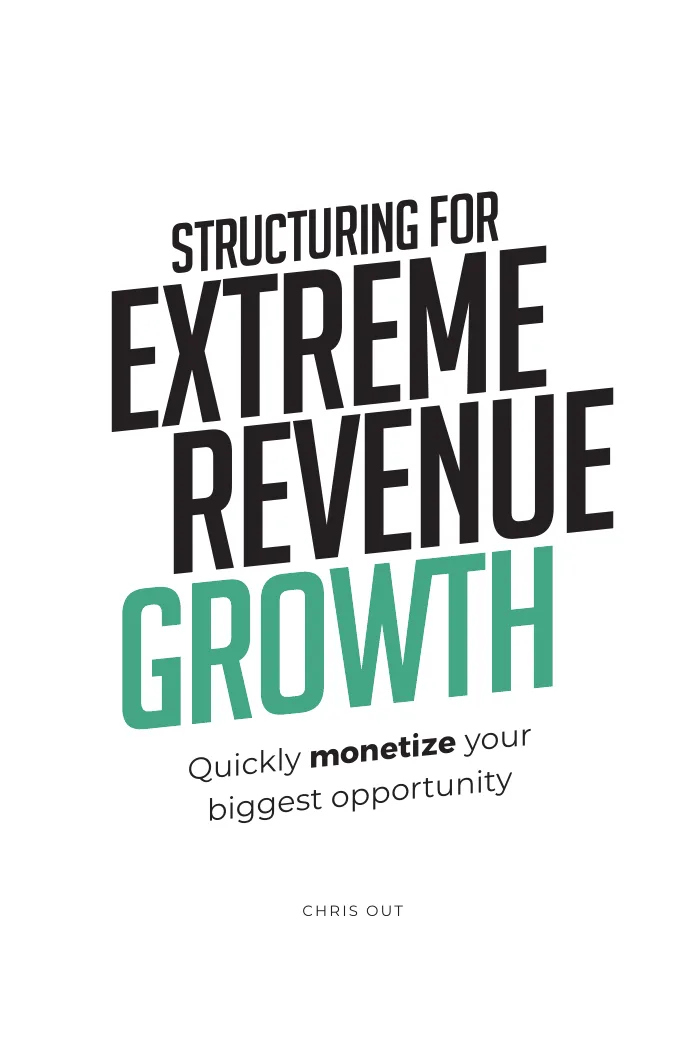
Cover of Structuring for Extreme Revenue Growth by Chris Out

Bonuses by chapter

  1. 01Your lost opportunity
  2. 02My Extreme Revenue Growth Story1 file
  3. 03Finding a suitable model of growth1 file
  4. 04Growth Hacking
  5. 05First Principles of Growth (Hacking)
  6. 06The WALLET Method
  7. 07Work once and get paid forever2 files
  8. 08Access accelerates growth3 files
  9. 09Lifetime growth3 files
  10. 10Let growth be easy3 files
  11. 11Every level has a growth devil2 files
  12. 12Tap into the hidden goldmine1 file
02Chapter 2Referenced on
p. 38

3 steps to fast learning

  • Worksheet3 Steps to Fast LearningPDF · 5 pages · 913 KBOpen PDF

This is the process I use with clients to speed up learning. The worksheet walks you through it. Below is the background for each step.

  1. Get clarity. Start with the end in mind. The exercise that changed my own direction is the Ideal Scene from Marc Allen's The Millionaire Course, which I did under the guidance of Chris Winfield in New York in 2017.
  2. Find the best shortcut. Success leaves clues. Once you know where you want to go, study the journey of people who already got there and copy the patterns in their mindset and behavior.
  3. Eliminate negative self-talk. Most good plans fail on execution, because people talk themselves down before they start.
The Ideal Scene questions

Imagine five years have passed and you live your ideal life. Take three minutes per question and write the answer down. I update this sheet every quarter.

What are you doing?

  • What kind of work and career do you have?
  • What is a typical day for you?
  • What do you do for relaxation and inspiration?
  • What are you doing to contribute to a better world?

What do you have?

  • What have you accomplished?
  • Where do you live, and what does your home look like?
  • What are your closest relationships like?
  • What is your family life like?

What kind of person are you?

  • What is the quality of your life like?
  • How would someone close to you describe you?
  • What are your physical and emotional states?
  • What are your mental and spiritual states?
The shortcut I used to write this book

Before writing Structuring for Extreme Revenue Growth I bought books and courses on how to write a book, which pitfalls exist and how to speed the process up. I spent a little over €1,000. It saved me hundreds of hours and got me a book deal.

The shortcut itself: delay the writing as long as you can still improve the structure. With a strong structure, writer's block rarely shows up.

Two exercises against negative self-talk

Steven Pressfield calls it resistance in The War of Art: the force that shows up whenever something brings short-term pain and long-term benefit. The answer is to begin. As Chris Winfield puts it: start before you're ready. Take at least one action toward your goal every day, however small.

If you doubt your ability, that is a problem of belief, not commitment. Financial mindset coach David Neagle uses this exercise:

  1. Spend an hour writing down every reason why your plan can't or won't work. Then take a break.
  2. Come back the next day and write down every reason why it can work. Don't judge the answers and don't change anything.
03Chapter 3Referenced on
p. 50

Socratic questioning

  • WorksheetSocratic QuestioningPDF · 6 pages · 920 KBOpen PDF

Socratic questioning is my main tool for finding the root causes of growth. I use it to get clarity on what a client wants, why they want it and which assumptions sit underneath. Coming at the same goal from different angles surfaces insights nobody had before.

My usual opening question:

Why can't it be done easier?

Six types of questions

Clarifying conceptsWhat exactly does this mean? Can you give me an example?
Probing assumptionsWhat else could we assume? What would happen if…?
Probing reasons and evidenceWhy is that happening? What evidence supports it?
Questioning viewpointsWho benefits from this? Why is it better than the alternative?
Probing implicationsDo these numbers make sense? What follows from that assumption?
Questioning the questionWhy do you think I asked this? What does that mean for you?

Go deeper

07Chapter 7Referenced on
p. 116, 117

Work once and get paid forever

  • WorksheetWork Once and Get Paid ForeverPDF · 4 pages · 90 KB · new in 2026Open PDF
  • Cheat sheetCopywriting Cheat SheetPDF · 5 pages · 474 KBOpen PDF

Ask yourself every day: did I build equity today? Take your agenda and to-do list and check each item: am I building an asset with this?

  • Level 1: less than 10% of your actions are asset-based.
  • Level 2: 10% to 50%.
  • Level 3: more than 50%. Push this as close to 100% as you can.

The worksheet covers the three action steps: repurpose what you already have, make your next action asset-based, and take a crash course in direct response copywriting.

Why copywriting

When I analyzed my most impactful mentors, they had one thing in common: all of them were highly skilled direct response copywriters. Copy forces you into the mind of your customer: what they need, hope, want and fear. And it scales. A text does the same work whether one person reads it or a million. You write it once and it keeps paying you back.

Courses I recommend
  • Copyhackers: Joanna Wiebe's resources and courses taught me a lot.
  • CopyHour: a 90-day course in which you copy classic ads by hand. I did it. You come out with a different copywriting brain.
Books that take you to the next level
  • The Ultimate Sales Letter by Dan S. Kennedy
  • The Architecture of Persuasion by Michael Masterson and Mike Palmer
  • Great Leads by Michael Masterson and John Forde
Formulas, and why they are not enough

Formulas get you started fast:

What makes copy work is research from many angles: the voice of your customer and what really resonates with them. How to write copy that'll blow your readers' minds (GrowthLab) explains this well.

08Chapter 8Referenced on
p. 129, 131

Access accelerates growth

  • WorksheetAccess Accelerates GrowthPDF · 6 pages · 510 KBOpen PDF
  • WorksheetTop 20 People ListPDF · 1 pages · 76 KBOpen PDF
  • E-bookBuilding a Dream 100PDF · 21 pages · 1.4 MBOpen PDF

The three action steps

  1. There is always leverage in your own network. Build your Top 20 list and your Dream 100.
  2. Know the budget you can spend on gaining more access: ads, relationship building and content creation.
  3. Work out for whom your access is valuable, and how to monetize it in a smart way.

The Top 20 list

Based on the principles of Chris Winfield and Jen Gottlieb of Super Connector Media. List everyone you know. Rate each person from 1 to 10 on influence: what their connections are worth. Rate them again from 1 to 10 on how likely they are to want to work with you. Add up the scores and start at the top.

Access through digital tools: no-code, Zapier and APIs

The second level of access runs through tools. In the early days of the internet, everything had to be hard-coded by developers. Today you build websites, landing pages and ad campaigns without writing a line of code, and that trend keeps accelerating.

Tools like Zapier, the "glue of the internet", connect apps through their APIs. Only when existing tools fall short do you need a developer to build an integration.

  • Zapier: start with their guides on connecting the tools you already use.
  • Treehouse: step-by-step courses to understand code, no-code and APIs. I have always pushed my teams to learn here.
09Chapter 9Referenced on
p. 136, 151, 153, 154

Lifetime growth

  • WorksheetLifetime GrowthPDF · 4 pages · 88 KB · new in 2026Open PDF
  • E-bookBuilding a Value LadderPDF · 54 pages · 1.8 MBOpen PDF
  • SlidesHow to Build Modular Go-to-Market Assets (Wynter Games talk)PDF · 51 pages · 8.1 MBOpen PDF

The three action steps: map your value ladder, assess its flexibility, and build a touch-based value ladder. The worksheet takes you through all three. The Wynter Games slides show step by step how I map a value ladder.

Consulting frameworks for the human touch

I went from €10 per hour to engagements above €1,000 per hour. These four principles drove that jump. They apply to anyone who wants to raise the value of the human touch in their business.

1. Every company hits a roadblock

A mindset I learned from Ramit Sethi's six-figure consulting program. Every company has problems, and if it keeps doing what it does, it will hit a roadblock. Your job is to find those roadblocks and guide the client around them. Socratic questioning (chapter 3) is the best way to find them.

2. Can you state precisely what your client sees as success?

Most people never fully understand when the other side is really happy with the work. I open every meeting, workshop and lecture by checking that my picture of success matches how the client puts it into words. In high-end work the nuances in wording matter. Ask yourself: do I know when my client is thrilled with my work?

3. What is closest to the money?

Find the last step before your client books revenue and start optimizing there. That is where your impact shows up in their books as extra revenue, which makes your value undeniable. The most common gap: follow-up. Companies don't follow up enough, or don't keep adding value while they do.

4. The gold lies on the other side of discomfort

There is so much money in things like follow-up because they are uncomfortable. Find what is uncomfortable for your client to do and start there.

A touch-based value ladder in practice: HubSpot

HubSpot knew that users who import their data into the CRM are far more likely to upgrade and stay. Users whose previous CRM was a spreadsheet struggled with exactly that step. HubSpot added a human hand-raise at that moment: free users could ask for personal help with the import. It became one of their most popular upgrade points, and it showed them how to improve onboarding for everyone. Kieran Flanagan describes the experiment in this Reforge article.

My own example from the book: buyers of a €47 email course got a phone call. Over 38% bought a coaching package, which made those customers 50 times more valuable.
10Chapter 10Referenced on
p. 166, 167

Let growth be easy

  • WorksheetLet Growth Be EasyPDF · 4 pages · 100 KB · new in 2026Open PDF
  • E-bookRevenue Stress TestingPDF · 22 pages · 1.4 MBOpen PDF
  • Cheat sheetGrowth Lever Cheat Sheet and 30-day challengePDF · 26 pages · 8.7 MBOpen PDF

Three levels of growth levers, from quick to thorough: your top 3 earners and burners, a revenue stress test, and a full Theory of Constraints analysis. The worksheet has a calculator for the stress test and a template for the five focusing steps.

(80/20)³ = 0.8 / 51.2 → less than 1% of your actions drive more than 50% of your results

The book promises the full guide on removing constraints, including the ones outside your organization:

Read the Theory of Constraints guide →

The four e-books in this section and in chapters 8, 9 and 11 work out the Growth Lever Cheat Sheet in practice. I wrote them with Marlies van den Brekel.

11Chapter 11Referenced on
p. 196, 200

Every level has a growth devil

  • WorksheetEvery Level Has a Growth DevilPDF · 5 pages · 473 KBOpen PDF
  • E-bookBuilding a Growth MindsetPDF · 32 pages · 1.5 MBOpen PDF

The three action steps

  1. Know your Kolbe A score.
  2. Start delegating.
  3. Build a leadership pipeline.

Where to learn which skill

SkillWhere
Direct response copywritingCopyhackers, CopyHour
Coding, no-code and APIsTreehouse
Digital marketing and product developmentReforge, CXL, GoPractice
12Chapter 12Referenced on
p. 209, 211

Tap into the hidden goldmine

  • WorksheetTap Into the Hidden GoldminePDF · 4 pages · 89 KB · new in 2026Open PDF

The MAGNET brings the book together: Modular asset building, Always-on layer, Growth levers, Next-level growth teams, Experimentation layer and Touch-based value ladder. You supercharge it through structured personal growth.

The three action steps

  1. Build your MAGNET.
  2. Do the growth assessment. The worksheet includes a scoring sheet for all six components.
  3. Test what works and what doesn't. Move every winner from the experimentation layer to the always-on layer.

The book promises more channel stacks and examples of the always-on and experimentation layers:

Read the channel stacks guide →

Since the book

Where I work now

I wrote this book after selling my growth hacking agency. At that agency, more than €250,000 per month was untouched revenue: revenue delivered without my involvement.

Today I coach agency owners with 2 to 10 people toward top 10% standards. The work runs on C.A.L.M.:

  • CClient happiness
  • AAutonomy
  • LLeads
  • MMargin

See how I work with agency owners →

Questions or feedback on the book: chris@chrisout.com